The Story is Bigger than most People realize
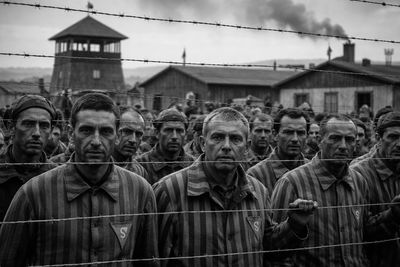
It must be told
Although the Spanish / Spaniards were the conquerers of the Aztecs and stripped them of their traditions, culture, heritage, religtion, etc. their DNA still is now mixed with most of ours in the present and thus the story must be told
Yes — Spaniards were in Nazi concentration camps (and the story is bigger than most people realize)
When people think of Nazi concentration camps in World War II, they usually picture the groups most commonly discussed in mainstream education: Jews, Roma, political dissidents, LGBTQ+ people, and others targeted by the Nazi racial state. But there’s another chapter that’s too often left in the shadows:
Thousands of Spaniards — overwhelmingly anti-fascist Republicans — were deported into the Nazi camp system.
Not because they “belonged” to Germany.
Not because Spain officially joined the Axis.
But because Spanish anti-fascists were hunted across borders, stripped of protection, and treated as disposable
The road into the camps: from the Spanish Civil War to Nazi captivity
After the Spanish Civil War (1936–1939), hundreds of thousands of Republican Spaniards fled into France as Franco’s regime consolidated power. Many were interned in harsh French camps, pressed into labor units, or later swept up in the chaos when Nazi Germany invaded and occupied France. Holocaust Encyclopedia
Once under German control, many Spaniards—especially those connected to Republican military units, resistance work, or labor battalions—became Nazi prisoners.
And here’s the cruel twist: they were often labeled “stateless.”
Not because they lacked identity… but because they were denied protection.
Mauthausen: the “Spanish camp”
While Spaniards were sent across the camp system, Mauthausen (Austria) became the central destination for Spanish Republican deportees.
A widely cited estimate: almost 10,000 Spanish Republicans were deported from prisons and POW camps, with around 7,500 ending up at Mauthausen. The Guardian+1
Mauthausen wasn’t just another camp: it became infamous for forced labor, brutality, and the stone quarry—where prisoners were worked, starved, beaten, and killed
The badge they were forced to wear: “S” for Spanier
In the camps, identity was reduced to cloth triangles stitched onto uniforms.
Spanish prisoners were commonly marked with a blue triangle (used for “stateless” people) and an “S” for “Spanier” (Spaniard)—a visual stamp of exile and abandonment. vscw.ca+1
That triangle matters. It’s proof in fabric: Spain’s anti-fascists were treated as people without a country—even though they absolutely had one.
Not only Mauthausen: Spaniards across the Nazi camp network
Although Mauthausen was the most concentrated site, Spanish deportees appear across major camps—Buchenwald, Dachau, Sachsenhausen, Ravensbrück, and even Auschwitz in certain victim groups and contexts. amical-mauthausen.org
This matters because it breaks the myth that Spaniards were “outside” WWII’s concentration camp history. They weren’t.
Evidence, memory, and the fight against erasure
One of the most famous Spanish survivors tied to Mauthausen is Francesc Boix, a Catalan photographer imprisoned there who helped preserve photographic evidence of Nazi crimes—material later used as proof in postwar prosecutions and historical documentation. Cadena SER+1
And organizations like Amical de Mauthausen have spent decades gathering names, testimonies, and records so the deportees don’t vanish into footnotes. amical-mauthausen.org+1
Also: institutions like the Arolsen Archives (home to vast Nazi-era documentation) have identified personal effects connected to Spanish prisoners, reinforcing how widespread these deportations were—and how many families are still searching for traces. Arolsen Archives
Why this belongs in a Mexican/Chicano space
Because fascism didn’t just target one community. It targets resistance, identity, and the poor and exiled—and it survives by making people forget who fought it.
Spanish Republicans in Nazi camps were anti-fascists punished twice:
- first by Franco’s victory
- then by Nazi imprisonment
- and finally by historical silence
That silence is political. And breaking it is, too.
If we claim our histories with pride—Mexican, Chicano, Indigenous, immigrant, worker—we also have to claim the histories of anti-fascist struggle that shaped the modern world, including the stories Spain tried to bury and Europe tried to file away.
A final note: “Were there Spaniards in German concentration camps?”
Yes.
And not just “a few.”
Thousands of Spaniards were deported into the Nazi camp system—many marked as stateless, many murdered, many surviving with lifelong scars, and many still missing from public memory. The Guardian+2EL PAÍS English+2
We remember them because forgetting helps the next wave of fascists.
And we’re not here to forget.